


Key Takeaways
- The election has reshaped Washington. Democratic control of Congress ushers in divided government, bringing political gridlock back into focus.
- Gridlock has historically favored markets, but the path may be bumpy. Fiscal standoffs and potential restrictions on AI data center development could introduce near-term volatility.
- Fundamentals remain the bigger story over the longer term. Resilient economic growth, strong corporate earnings, and continued business investment provide a solid foundation for markets beyond the election cycle.
The votes have been cast, and Washington is entering a new political chapter. With Democrats gaining control of Congress, divided government returns, raising questions about what political gridlock could mean for investors.
For markets, the question is: What happens next? History offers a surprisingly interesting perspective.
Markets Don't Vote Red or Blue
According to analysis of S&P 500 performance following U.S. elections from 1980 through 2024, stocks delivered positive returns in 19 of the 21 subsequent one-year periods.
Perhaps more interesting, those gains occurred under divided government, unified Democratic control, and unified Republican control.
The two exceptions followed the 1980 and 2000 elections, when broader economic challenges played a significant role in market performance.
But there's another important lesson: Markets often value the certainty of an election outcome more than the outcome itself. Once the results are known, businesses can plan, invest, and move forward. Sometimes, the uncertainty leading up to an election can be more disruptive than the result.
The message is compelling: Markets have historically rewarded investors across political divides.
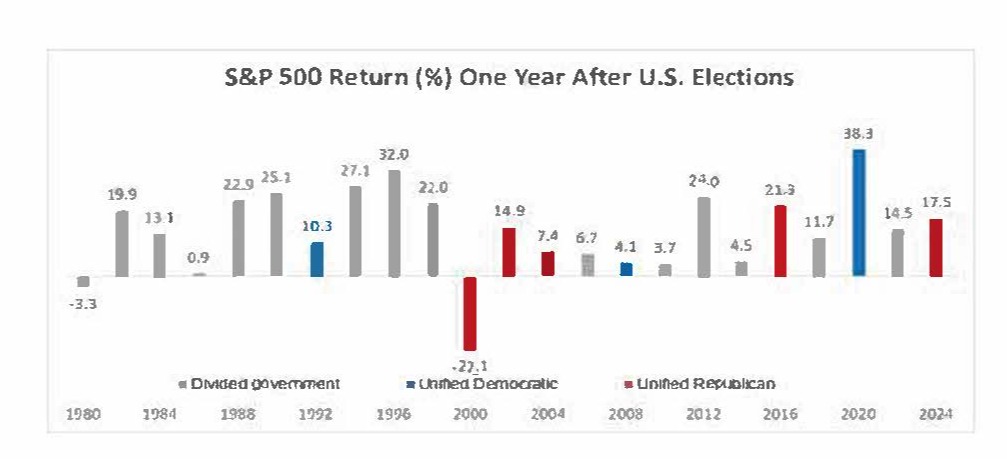
Source: Oxford Economics. FactSet.
Does Divided Government Still Mean Gridlock?
Wall Street has traditionally welcomed divided government because it can limit sweeping legislative changes. But gridlock is not always synonymous with stability.
With federal debt elevated, disagreements over government spending and the debt ceiling could create additional uncertainty. Prolonged fiscal standoffs could push Treasury yields higher, weighing on stock valuations.
Another area worth watching is the AI investment boom. Greater scrutiny of data center development, including potential restrictions on construction and energy use, could slow investment in an industry that has become an important driver of economic growth.
But campaigning against data centers is one thing; governing is another. Data centers can be significant economic engines for individual states, supporting construction, infrastructure investment, and local tax revenues. That creates a powerful incentive for policymakers to balance regulatory concerns with economic opportunity. As a result, restrictions may ultimately prove less severe than investors fear.
Meanwhile, executive authority continues to play an important role in trade and foreign policy, regardless of which party controls Congress. Political gridlock may therefore do little to reduce uncertainty surrounding tariffs or geopolitical developments.
These risks could introduce near-term market volatility, but political uncertainty does not necessarily translate into economic weakness or a sustained market downturn.
Fundamentals Still Have the Final Say
The good news is that the economy enters this new political chapter on relatively solid footing.
Corporate earnings remain robust, business investment continues to expand, and AI-related spending is supporting economic activity. According to Oxford Economics, AI-related investment and the associated wealth effect accounted for roughly 30% of total growth.
That contribution is significant, but it also highlights vulnerability. A slowdown in AI investment or a sustained decline in technology stocks could weigh on both business spending and consumer confidence.
Other challenges remain. Inflation is proving persistent, borrowing costs are elevated, and geopolitical uncertainty continues to influence energy prices.
Still, these risks do not erase the underlying strength of the economy. Resilient growth, healthy corporate profits, and continued investment provide a meaningful foundation for markets, even as political uncertainty creates bumps along the way.
What Should Investors Do?
Elections can create uncertainty, and markets may react sharply to unexpected policy developments. But history offers little evidence that investors consistently benefit from making portfolio decisions based on political predictions.
Instead, investors should focus on the forces that ultimately drive returns: corporate profits, economic growth, inflation, and interest rates.
Diversification remains particularly important when market leadership is shifting, and policy uncertainty is elevated. A portfolio aligned with long-term objectives is a more reliable strategy than attempting to anticipate the next political headline.
The Bottom Line
Elections determine who makes policy, but economic fundamentals ultimately shape investment returns. Political gridlock may create near-term turbulence, yet history reminds us that markets can thrive under either party. With economic growth resilient and corporate earnings strong, investors have good reason to stay focused on the longer-term picture.
This material is intended for general use. By providing this content Park Avenue Securities LLC and your financial representative are not undertaking to provide investment advice or make a recommendation for a specific individual or situation, or to otherwise act in a fiduciary capacity.
This material was produced by an independent third party. It is provided for informational and educational purposes only. The views and opinions expressed herein may not be those of Guardian Life Insurance Company of America (Guardian) or any of its subsidiaries or affiliates. Guardian does not verify and does not guarantee the accuracy or completeness of the information or opinions presented herein. 7727964.32 Exo 11/28.
Securities products and advisory services offered through Park Avenue Securities LLC (PAS) member FINRA, SIPC, OSJ: 6115 Park South Drive Suite 200 Charlotte NC 28210, 704-552-8507. PAS is a wholly-owned subsidiary of The Guardian Life Insurance Company of America (Guardian) New York, NY. Genesis Wealth Planning is not an affiliate or subsidiary of PAS or Guardian.