


Key Takeaways
- The S&P 500 is currently in a state of excessive concentration and is at the lowest level of diversification since 1973.
- When the excessive concentration reaches its tipping point, the change in market leadership can be quick and durable.
- Portfolio diversification across market capitalizations and investment styles, including the use of active managers, can provide meaningful results when the cycle turns.
The U.S. equity market, as represented by the S&P 500, has seen two years of above 20% returns as the largest companies in the index drove the market higher. Is this market concentration normal, or has broad diversification in an index dissolved?
Market Concentration
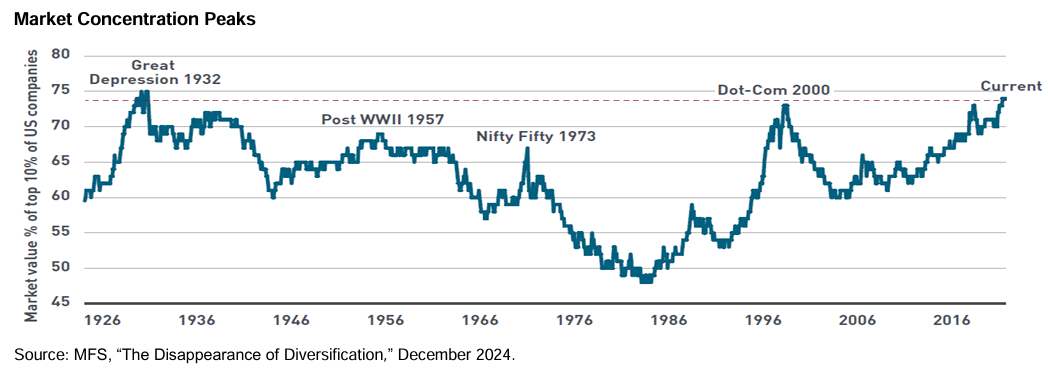
We’ve all seen the acronyms for companies leading the S&P 500 higher over the years. FANG became the Magnificent Seven, which became BATMMAAN this year. Today, the market concentration is at its peak, with the top 10 holdings representing 75% of the total market value.
At the end of 2024, the top 10 stocks represented almost 40% of the index, significantly up from 23% five years ago and 18% 10 years ago. As the concentration in the top 10 stocks grew over the past five years, they made up almost 40% of the S&P 500 return. Compare that to the dot-com bubble when the top 10 drove 15% of the returns.
Because of this build-up in the top holdings, the index is actually trading like a concentrated portfolio of 45 stocks rather than a diversified index of 500 stocks.
Post Concentration Peak
With the market at such a high peak of concentration, the question may be what happens next. All historic peaks have seen a tipping point when concentration gives way to broader
diversification.
Looking back to the Nifty Fifty and Dot Com peaks, research shows that the top 10 stocks went on to trail the broader S&P 500 over the 3-, 5-, and 10-year periods following the peak.
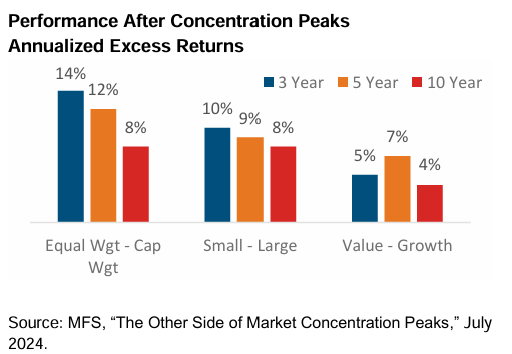
As the excessive concentration dissipates, the areas of the market that previously lagged tend to come back into favor, as seen in the chart above. Equal-weighted equities handily outperformed capitalization-weighted equities over the subsequent periods. We also saw smaller caps outperform large caps and value stocks outperform growth stocks.
Opportunities to Diversify
Just as the market cycles from peak to trough, so does the cycle from concentration to diversity. The excessive concentration in the U.S. market today means we should find ways to diversify portfolios to prepare for the next part of the cycle.
Consider ways to diversify index concentration by looking at smaller-cap companies or taking value-style exposures. Also, consider including active managers who are seeking
opportunities outside of the concentrated top 10 stocks in the index.
It may be difficult not to be lured by the strong returns of the concentrated large-cap indices, especially as we don’t know when the cycle may end. But, when the tipping point
does occur, we need to ensure our portfolios are prepared, as the changing tides can be dramatic and long-lasting.
This material was produced by an independent third party. It is provided for informational and educational purposes only. The views and opinions expressed herein may not be those of Guardian Life Insurance Company of America (Guardian) or any of its subsidiaries or affiliates. Guardian does not verify and does not guarantee the accuracy or completeness of the information or opinions presented herein.
Registered Representative and Financial Advisor of Park Avenue Securities LLC (PAS). Securities products and advisory services offered through PAS, member FINRA, SIPC. Financial Representative of The Guardian Life Insurance Company of America® (Guardian), New York, NY. PAS is a wholly owned subsidiary of Guardian. Genesis Wealth Planning, LLC is not an affiliate or subsidiary of PAS or Guardian. CA Insurance License Number - 0M50974. This material is intended for general use. By providing this content The Guardian Life Insurance Company of America, Park Avenue Securities LLC, affiliates and/or subsidiaries, and your financial representative are not undertaking to provide advice or make a recommendation for a specific individual or situation, or to otherwise act in a fiduciary capacity. Guardian, its subsidiaries, agents and employees do not provide tax, legal, or accounting advice. Consult your tax, legal, or accounting professional regarding your individual situation. Links to external sites are provided for your convenience in locating related information and services. Guardian, its subsidiaries, agents and employees expressly disclaim any responsibility for and do not maintain, control, recommend, or endorse third-party sites, organizations, products, or services and make no representation as to the completeness, suitability, or quality thereof. 7727964.1 Exp. 12/2025.